Showing posts with label research. Show all posts

Wednesday, November 2, 2016

Parent-Led Intervention May Reduce Autism Severity

Check out this new research on parent training and parent lead interventions.
We are currently providing the opportunity for a parent coaching scholarship.

Application and more information: http://www.unicornchildrensfoundation.org/esdm

Parent-Led Intervention May Reduce Autism Severity
by Shaun Heasley 

For the first time, researchers say they have evidence that parent-led intervention for young kids with autism continues to yield gains several years later.
Children who participated in an intervention between the ages of 2 and 4 displayed less severe symptoms six years later, exhibiting fewer repetitive behaviors and better social communication, according to findings published this week in the journal The Lancet.
“Our findings are encouraging, as they represent an improvement in the core symptoms of autism previously thought very resistant to change,” said Jonathan Green of the University of Manchester and Royal Manchester Children’s Hospital in England who led the study.
The findings come from a follow-up to what’s known as the Preschool Autism Communication Trial, or PACT, which was published in 2010.
For the trial, children with autism were randomly assigned to either participate in a 12-month early intervention program or simply receive standard care. All of the kids initially displayed similar levels of autism severity.
Parents of those in the intervention group participated in 18 sessions over the course of the year where they watched videos of themselves interacting with their child and got feedback from therapists so that they could understand how to better communicate. These moms and dads also agreed to spend 20 to 30 minutes each day engaged in planned communication and play with their child.
Six years after completing the initial study, researchers conducted new assessments of 59 children who received the parent-focused intervention and 62 kids who did not. They found that 17 percent fewer children in the intervention group had severe symptoms as compared to kids whose parents did not get the specialized training.
What’s more, researchers found that children in the treatment group communicated better with their parents even though assessments showed no difference in language scores between them and the other kids studied. However, both groups of youngsters continued to display comparable levels of anxiety, challenging behaviors and depression.
“This is not a ‘cure,’ in the sense that the children who demonstrated improvements will still show remaining symptoms to a variable extent, but it does suggest that working with parents to interact with their children in this way can lead to improvements in symptoms over the long-term,” Green said.

Wednesday, September 10, 2014

Reversing autism? Treating infants for disorder may eliminate symptoms

While it is a very small sample size, it has some interesting potential.

Via WPTV: Can autism be reversed? A study finds early intervention could significantly reduce or eliminate all symptoms autism by the age of three. The treatment included coaching to help parents increase their infant's attention. Check out this groundbreaking study and share with other parents: http://bit.ly/1nJ7p09

Friday, June 20, 2014

MIT Researcher’s New Warning: At Today’s Rate, Half of All U.S. Children Will Be Autistic (by 2025)

Research scientist Stephanie Seneff of the Massachusetts Institute of Technology (MIT), a widely published author on topics ranging from Azlheimer’s Disease to autism and cardiovascular disease, raised plenty of eyebrows recently with a bold proclamation on autism at a special panel in Massachusetts about genetically modified organisms and other topics.
“At today’s rate, by 2025, one in two children will be autistic,”  Seneff said last Thursday in Groton, MA at an event sponsored by the holistic-focused Groton Wellness organization.
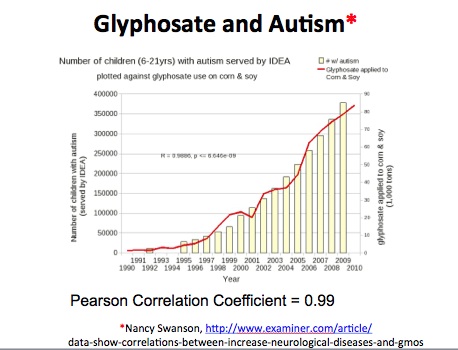
Seneff presented slides showing a remarkably consistent correlation between the rising use of Roundup (with its active ingredient glyphosate) on crops and the rising rates of autism; while it doesn’t show a direct correlation it does give researchers plenty to think about, especially considering Seneff’s research into the side effects of autism that mimic glyphosate toxicity and deficiencies.
The slide notes that the heaviest use of Roundup, Monsanto’s flagship weedkiller, began in 1990 and continued to rise since. Meanwhile, the  number of kids with autism has gone from 1 in 5,000 in 1975 to 1 in 68 today, a puzzling and frustrating stat that shows no signs of slowing down and one that correlates strongly with the rise in glyphosate use.
Of course, autism is a complex problem with many potential causes, but the numbers are particularly of note considering how close the correlation is, and Seneff’s credentials.
Seneff's slide showing a strong correlation between Roundup and autism rates.
Seneff’s slide showing a strong correlation between Roundup and autism rates.
Dr. Seneff has written 10 papers (7 as the first author) in various medical and health journals on modern diseases as well as drug side effects, nutritional deficiencies and the impacts of environmental toxins on our health. She also worked as a Senior Research Scientist at the MIT Computer Science and Artificial Intelligence Laboratory before turning to biology, as her official biography notes.
You can read more about her presentation on the website The Complete Patient by clicking here,and you can also check out the full versions of her slides on glyphosate and autism by clicking here.