Showing posts with label children. Show all posts

Tuesday, February 3, 2015

Do You Provide Services?

If you provide services for special needs children and want to be included in our directory, please email the following information to sharon@eunicorn.org : 

- Program/Agency Name
- Address
- Phone Number
- Email Address
- Website
- Brief description of services

Friday, August 29, 2014

Pediatrician Education Campaign

Unicorn Children’s Foundation, in collaboration with community partners, will be launching a Pediatrician Education Campaign this upcoming year to ensure pediatricians know where to refer families for service. To participate or for more information, contact Executive Director, Sharon Alexander, at sharon@eunicorn.org.

http://pediatrics.aappublications.org/content/early/2014/08/19/peds.2014-1839.full.pdf+html?sid=79fcd0ee-a591-4a1c-8c74-326899f35e09


Friday, June 20, 2014

MIT Researcher’s New Warning: At Today’s Rate, Half of All U.S. Children Will Be Autistic (by 2025)

Research scientist Stephanie Seneff of the Massachusetts Institute of Technology (MIT), a widely published author on topics ranging from Azlheimer’s Disease to autism and cardiovascular disease, raised plenty of eyebrows recently with a bold proclamation on autism at a special panel in Massachusetts about genetically modified organisms and other topics.
“At today’s rate, by 2025, one in two children will be autistic,”  Seneff said last Thursday in Groton, MA at an event sponsored by the holistic-focused Groton Wellness organization.
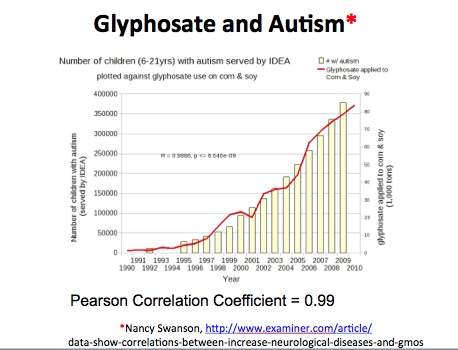
Seneff presented slides showing a remarkably consistent correlation between the rising use of Roundup (with its active ingredient glyphosate) on crops and the rising rates of autism; while it doesn’t show a direct correlation it does give researchers plenty to think about, especially considering Seneff’s research into the side effects of autism that mimic glyphosate toxicity and deficiencies.
The slide notes that the heaviest use of Roundup, Monsanto’s flagship weedkiller, began in 1990 and continued to rise since. Meanwhile, the  number of kids with autism has gone from 1 in 5,000 in 1975 to 1 in 68 today, a puzzling and frustrating stat that shows no signs of slowing down and one that correlates strongly with the rise in glyphosate use.
Of course, autism is a complex problem with many potential causes, but the numbers are particularly of note considering how close the correlation is, and Seneff’s credentials.
Seneff's slide showing a strong correlation between Roundup and autism rates.
Seneff’s slide showing a strong correlation between Roundup and autism rates.
Dr. Seneff has written 10 papers (7 as the first author) in various medical and health journals on modern diseases as well as drug side effects, nutritional deficiencies and the impacts of environmental toxins on our health. She also worked as a Senior Research Scientist at the MIT Computer Science and Artificial Intelligence Laboratory before turning to biology, as her official biography notes.
You can read more about her presentation on the website The Complete Patient by clicking here,and you can also check out the full versions of her slides on glyphosate and autism by clicking here.

Thursday, November 7, 2013

Behavioral issues in children with autism may be due to stomach problems

Kids with autism have significantly more problems with diarrhea, food sensitivity and constipation than their typically developing peers. Furthermore, these gastrointestinal problems (GI) may be the cause of social withdrawal, irritability and repetitive behavior, according to a study published on the 6th of November.

Researchers from the MIND Institute at the University of California, Davis studied nearly 1,000 children with autism and developmental delays. The kids with autism and GI problems also had more problems with irritability, social withdrawal, repetitive behavior and hyperactivity.

“After years of parents raising concerns about such symptoms, the huge differences we see between parental reports on children with autism spectrum disorder versus those on children with typical development puts to rest the idea that gastrointestinal problems among children with autism spectrum disorder are just an accumulation of case reports,” said Irva Hertz-Picciotto, principal investigator for the study. “Our data clearly show that gastrointestinal problems are very common in children with autism.”

The research team concluded that the pain and discomfort of GI problems could cause or contribute to social withdrawal and irritability in children with autism. They recommend that any child with autism and GI problems have a full GI screening. Then any potential GI problems found could be addressed and that may lead to a decrease in behavioral issues.

The study, “Gastrointestinal Problems in Children with Autism, Developmental Delays or Typical Development” is published in the Journal of Autism and Developmental Disorders.

Credit: http://advocacyinactionireland.blogspot.com/2013/11/behavioral-issues-in-children-with.html?utm_source=feedburner&utm_medium=email&utm_campaign=Feed%3A+AdvocacyInAction+%28Advocacy+in+Action%29